

Why Hackers Target Businesses That Lack a Dedicated Security Team
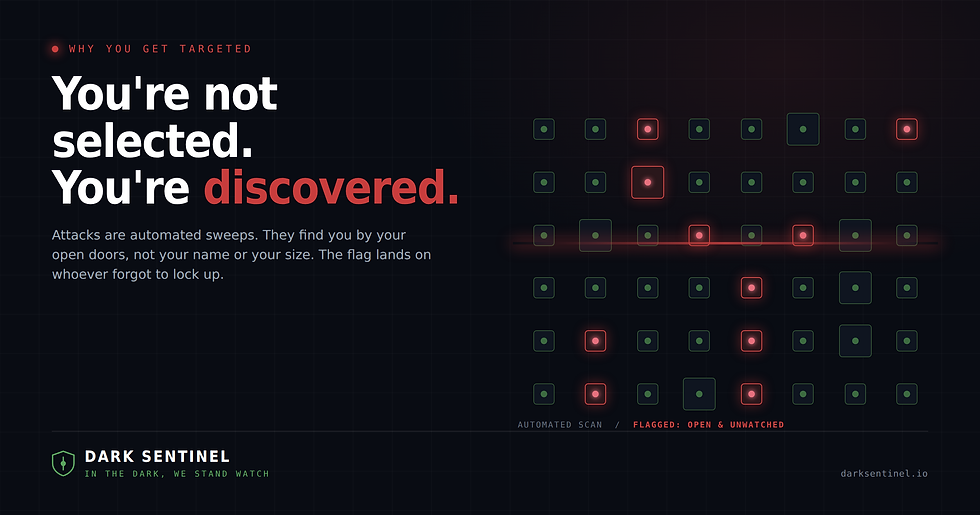
Hackers target businesses without a dedicated security team not because those businesses are valuable, but because they are reachable and unwatched. Modern attacks are automated and opportunistic. Software scans the entire internet looking for weak points, and it finds businesses by their open doors, not by their name or size. A business with no one watching is easier to break into, slower to notice the intrusion, and more likely to pay to make it stop. That combination is exactly what attackers optimize for. The 2026 Verizon Data Breach Investigations Report found that among ransomware victims whose size was known, 96 percent were small and mid-sized businesses, and concluded that attackers hit them opportunistically. The vulnerability that draws them is not the size of your company. It is the absence of anyone on watch. Here is how that actually works, and what changes it.
Do hackers really target smaller businesses on purpose?
The most damaging myth in security is "we are too small to be a target." It feels reasonable. Why would a criminal bother with a twelve-person firm when there are banks and hospitals to hit?
The answer is that they do not choose between you and a bank. They hit both, because they are not choosing at all. The vast majority of attacks are not personal. They are automated sweeps that probe millions of systems and exploit whatever is weak, wherever it is found. To that software, a dental practice with an unpatched firewall and a Fortune 500 company with the same flaw look identical. You are not selected. You are discovered. And a business without a security team tends to have more of what the automated sweep is looking for, and fewer people positioned to notice when it succeeds.
Once you understand that attacks are opportunistic rather than targeted, the reasons these businesses get hit fall into place.
Reason 1: Automation means being small does not hide you
Attackers run tools that continuously scan the internet for exposed services, unpatched devices, and known vulnerabilities. When the tool finds one, it can exploit it automatically, often within hours of a vulnerability becoming public.
Vulnerability exploitation became the single most common way into a breach in the 2026 DBIR, overtaking stolen credentials. Unpatched perimeter devices, the firewall or VPN nobody updated, are being compromised at scale by software that never sleeps and does not care how big you are. Being a modest business does not move you off the map. Everything with an internet connection is on the map. The only question the automated attacker asks is whether you are patched, and a business with no one responsible for that is far more likely to answer no.
Reason 2: Nobody is watching, so attacks succeed and go unnoticed
This is the core of it. An attack that would be caught in minutes at a monitored business runs undisturbed for months at an unmonitored one.
IBM's 2025 Cost of a Data Breach Report found it took organizations an average of 241 days to identify and contain a breach, and that was a nine-year low. At a business with no security team, that clock runs even longer, because there is no one whose job is to watch the logins, the alerts, or the mailbox rules. An attacker who gets in has time: time to read your email, map your systems, find where the money and the sensitive data live, and disable your backups before triggering ransomware. The absence of monitoring does not just make the break-in easier. It makes the damage far worse, because nothing interrupts it.
Reason 3: The common gaps are wide open
Businesses without dedicated security tend to share the same handful of unlocked doors, and attackers know exactly which ones to try.
Stolen and reused passwords remain a leading way in, and the human element was involved in 62 percent of breaches in the 2026 DBIR. Multi-factor authentication, which blocks most credential-based attacks, is often not turned on everywhere. Patching falls behind because no one owns it. Phishing emails land because no one has trained the team to spot them. None of these gaps require a sophisticated attacker. They require an unlocked door and someone checking the handle, and the automated sweeps check every handle.
Reason 4: You are a doorway to bigger targets
Even when your business is not the ultimate prize, you can be the way in to one.
Third parties were involved in 55 percent of breaches affecting small and mid-sized businesses in the 2026 DBIR, and attackers increasingly use one business to reach its partners and clients. If you are a vendor, a supplier, or a service provider to larger organizations, your access to their systems and data makes you a target by association. You hold your clients' information and, often, a trusted connection into their networks. Compromising you is a quieter path to them than attacking them directly. This is why "we do not have anything worth stealing" is rarely true. Your access is worth stealing, even when your own data is not the goal.
Reason 5: The payoff is reliable
Attackers keep hitting these businesses for the simplest reason of all: it works, and it pays.
A business without a security team usually cannot recover quickly from ransomware, which raises the odds it pays to get running again, or suffers costly downtime if it does not. Encouragingly, more victims are refusing: the 2026 DBIR found 69 percent of ransomware victims did not pay. But paying or not, the cost lands. Sophos put the average ransomware recovery cost for a business of 100 to 250 people at $638,536, before any ransom. From the attacker's view, a target that is easy to breach, slow to detect the breach, and under pressure to restore operations is a reliable return. That is the whole business model.
The pattern behind all five: it is a capability gap, not a size problem
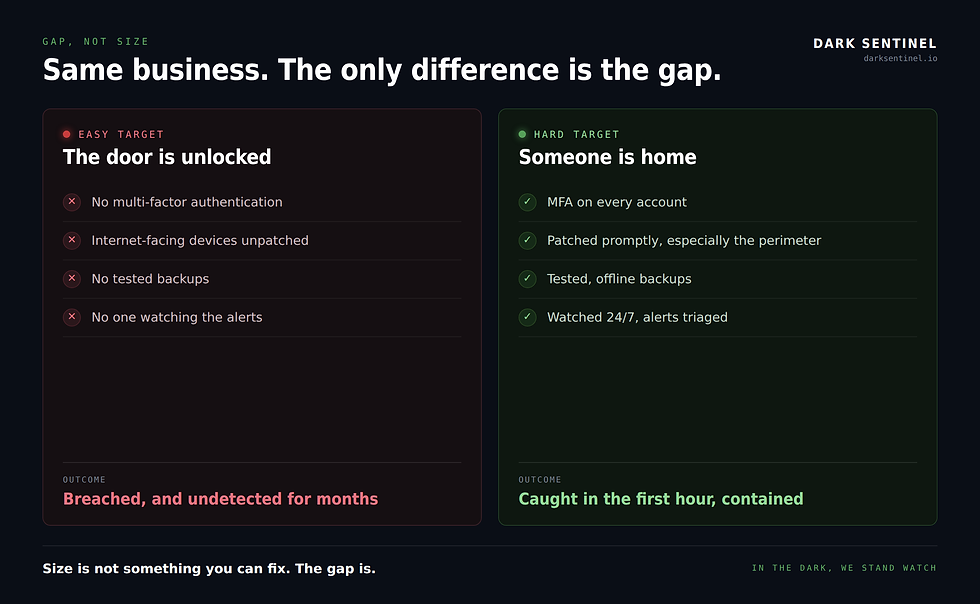
Look at those five reasons together and the real issue is clear. None of them is about how big your company is. Every one is about capability: whether systems are patched, whether logins are protected, whether backups exist, and above all whether anyone is watching. A ten-person business with strong fundamentals and real monitoring is a hard target. A larger business with none of that is an easy one.
The thing attackers exploit is not your size. It is the gap left when no one is responsible for security. That reframing matters, because size is not something you can fix, but the gap is. You do not need to become a large company to stop being an easy target. You need to close the capability gap, and that is a smaller and more achievable thing than most business owners assume.
What actually changes the equation
The defenses that move you from easy target to hard target are not exotic, and they map directly to the five reasons above.
Turn on multi-factor authentication everywhere, which closes the credential door. Patch promptly, especially internet-facing devices, which removes the automated sweep's favorite entry point. Keep tested, offline backups, which removes the attacker's leverage. And most importantly, make sure someone is actually watching, around the clock, so an intrusion is caught in its first hour instead of its hundredth day.
That last one is the piece most businesses cannot staff on their own, and it is the entire reason managed detection and response exists. Our full explainer on managed detection and response covers how a team can watch your environment continuously without you hiring one. The gap is real, but it is closable, and closing it is what takes you off the easy-target list.
The bottom line
Hackers do not target businesses without security teams because those businesses are important. They target them because they are reachable, unwatched, and slow to recover, and because automated tools find them by their weaknesses regardless of size. The good news inside that hard truth is this: the thing being exploited is a gap, not your size, and gaps can be closed. The businesses that stop getting breached are not the ones that got bigger. They are the ones that made sure someone was watching.
Most businesses can't afford a security team. Dark Sentinel gives them one. 24/7 managed detection and response.
Want to know where your gaps are before an attacker finds them? Contact us to start the conversation. You can book a Free Security Strategy Session, email info@darksentinel.io, or call (281) 270-9948. No pressure, no obligation, just a clear look at what would take your business off the easy-target list.
IN THE DARK, WE STAND WATCH
Frequently Asked Questions
Why would hackers target a smaller business? Because most attacks are automated and opportunistic, not personal. Software scans the internet for weak points and exploits whatever it finds, regardless of company size. Businesses without a dedicated security team tend to have more open gaps and fewer people watching, which makes them easier to breach and slower to detect it.
Is my business too small to be a target? No. The idea that a business is "too small to target" is a myth. The 2026 Verizon DBIR found that 96 percent of ransomware victims whose size was known were small and mid-sized businesses. Attackers find you by your vulnerabilities, not your size.
What makes a business an easy target? Unpatched internet-facing devices, no multi-factor authentication, reused or stolen passwords, no tested backups, and no one monitoring for intrusions. These gaps, not company size, are what attackers exploit.
How do attackers use a small business to reach a larger one? If you are a vendor or service provider, your access to a larger organization's systems and data makes you a quieter path in than attacking them directly. Third parties were involved in 55 percent of breaches affecting small and mid-sized businesses in the 2026 DBIR.
What is the single most effective thing to reduce the risk? Make sure someone is actually watching your environment around the clock so intrusions are caught early. Combined with multi-factor authentication, prompt patching, and backups, continuous monitoring is what moves a business from easy target to hard target.


Comments