

What Is Managed Detection and Response (MDR), and Does Your Business Actually Need It?

Managed detection and response (MDR) is a service that gives your business a team of security analysts who monitor your systems 24/7, investigate suspicious activity, and actively shut down attacks before they cause damage. It combines detection software with human experts who respond on your behalf. Unlike antivirus, which blocks known threats automatically and stops there, MDR catches the attacks that slip past prevention tools and gets a real person involved within minutes. Businesses adopt MDR when they need round-the-clock security coverage but do not have the staff, budget, or expertise to build a security operations center of their own.
That is the short answer. The longer answer is worth your time, because MDR is one of the most misunderstood categories in security, and the misunderstanding costs businesses real money.
What does MDR actually do?
MDR has four parts working together. Miss any one of them and it is not MDR.
It monitors continuously. Sensors sit on your laptops, servers, and cloud workloads, feeding activity data to a security operations center that watches it every hour of every day. Attackers know this, which is why the majority of intrusions start on nights, weekends, and holidays.
It detects what prevention misses. Modern attacks often use no malware at all. An attacker who steals a valid password and logs in looks exactly like an employee to an antivirus tool. MDR detects the behavior instead of the file: the account that logged in from two countries in an hour, the finance workstation suddenly scanning the network, the tool that just tried to disable your backups.
It investigates with human analysts. Detection software produces alerts. Most of them are noise. Someone has to look at each one and decide whether it is a false positive or the first hour of a ransomware incident. That triage is the part businesses cannot do themselves at 2 a.m.
It responds, not just reports. This is the line that separates MDR from everything else. When something real is found, the analyst takes action: isolating the infected machine from the network, killing the malicious process, disabling the compromised account. A tool that emails you an alert and waits is monitoring. A service that contains the threat while you sleep is MDR.
How is MDR different from antivirus or EDR?
These get used interchangeably, and vendors are not always eager to clarify. Here is the honest breakdown.
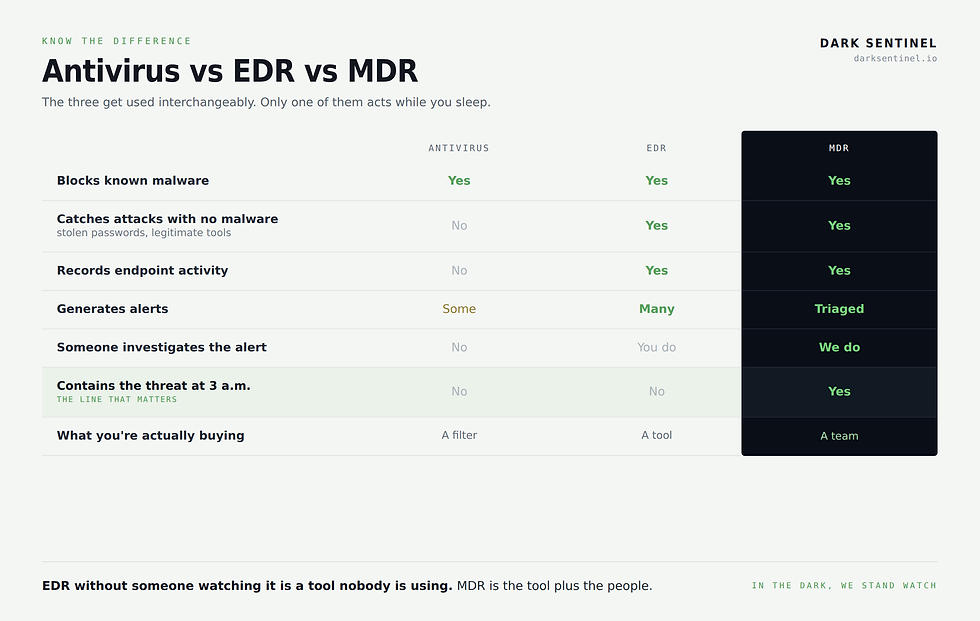
Antivirus blocks known bad files by matching them against a list of known threats. It is necessary and nowhere near sufficient. It is blind to attacks that use stolen credentials or legitimate system tools, which is now most of them.
EDR (endpoint detection and response) is the software layer. It records everything happening on your endpoints and can detect suspicious behavior rather than just known files. EDR is genuinely powerful, and it is also the source of a common expensive mistake: EDR is a tool, not a service. It generates alerts. Someone still has to read them, investigate them, and act. Businesses buy EDR, feel protected, and discover during an incident that nobody was watching the console.
MDR is EDR plus the humans. You get the detection technology and the analysts who operate it around the clock. The distinction matters most at the exact moment it counts: when the alert fires at 3 a.m. on a Saturday.
Why can't we just handle this in-house?
You can, and some businesses should. It is worth being clear-eyed about what it takes. Genuine 24/7 coverage requires roughly five to six full-time analysts once you account for three shifts, weekends, vacation, and turnover. Experienced security analysts are expensive and scarce, and in most markets they are being recruited away constantly. You also need the detection platform itself, the tuning expertise to keep it from drowning your team in false positives, and the threat intelligence to know what to look for this month.
For most businesses outside the Fortune 500, the math does not work. That is the entire reason MDR exists as a category: it spreads the cost of a security operations center across many clients so each one can afford a capability that would otherwise be out of reach.
The realistic alternative is not usually "build a SOC." It is "our IT provider keeps an eye on things." That is a real gap, and it is worth naming plainly: general IT support and security operations are different disciplines. Your IT provider keeps systems running. Security operations assumes someone is actively trying to break in and hunts for them. Excellent IT teams are often the first to say so.
Does your business actually need MDR?
Not every business does. Here is an honest test.
You probably need MDR if any of these are true:
You have no one whose actual job is security, and after 6 p.m. nobody is watching anything.
You hold data that would hurt you badly if it leaked: client records, patient files, financial details, escrow funds, proprietary designs.
Downtime costs you real money by the hour. If your operation stops when your systems stop, ransomware is an existential risk, not an IT inconvenience.
Your cyber insurance renewal is asking about endpoint detection and response capability. Underwriters increasingly require it, and answering "no" changes your premium or your coverage.
Your customers or partners are starting to ask how you protect their data.
You already own security tools but nobody is monitoring the alerts they generate.
You may not need MDR yet if:
You are a handful of people with no sensitive data and no operational dependency on your systems. Strong basics may be enough for now: multi-factor authentication everywhere, managed backups, patching, and DNS filtering.
We would rather tell you that than sell you something you do not need. If the basics are your gap, fix the basics first.
What should you look for in an MDR provider?
Ask these questions and listen closely to the answers.
Do you respond, or do you just alert me? If the answer involves the word "notify" and nothing else, it is not MDR. Ask specifically what actions they will take without waiting on you, and get it in writing.
Who is watching at 3 a.m. on a Sunday? Ask whether coverage is a staffed shift or an on-call rotation. Ask where the analysts are and whether they are employees.
How fast do you respond, and is it contractual? Detection time and response time should be committed numbers, not marketing adjectives.
What platform is this built on? You should recognize the name. Ask whether you keep access to the console and the data.
What happens during a real incident? Walk through it. Who calls whom, at what number, and what do they do in the first fifteen minutes?
What does onboarding look like? Good MDR should be live in days, not quarters.
How much does MDR cost?
Pricing is typically per endpoint per month, which means it scales with your business rather than requiring a large capital commitment up front. A useful frame: compare it against one security analyst's fully loaded salary, then remember that one analyst gives you eight hours a day, five days a week, minus vacation. MDR gives you the other 128 hours.
The other comparison worth running is against a single ransomware incident. Between downtime, recovery, legal exposure, breach notification, and lost customers, the cost of one serious incident tends to dwarf years of monitoring. We break those numbers down in detail in our post on the real cost of a data breach.
The bottom line
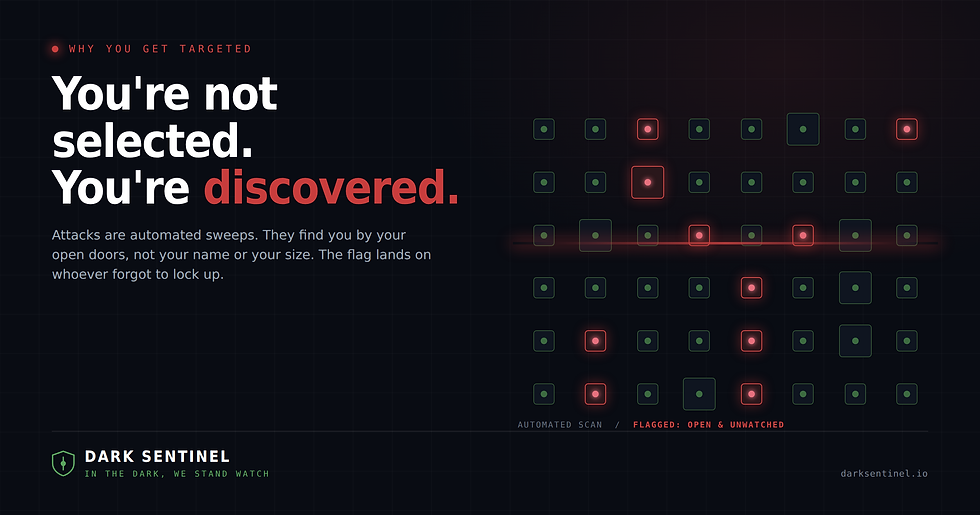
MDR exists because the security problem outgrew the security staffing model. Attacks are constant, automated, and increasingly aimed at businesses that attackers correctly assume are not watching. The gap is not company size. It is whether anyone is on duty.
If nobody at your business is watching tonight, that is the gap MDR fills.
Most businesses can't afford a security team. Dark Sentinel gives them one. 24/7 managed detection and response, built on CrowdStrike Falcon.
Book a Free Security Strategy Session. No pressure, no obligation. We will walk through what you have, where the gaps are, and what actually matters for your business.
IN THE DARK, WE STAND WATCH
Frequently Asked Questions
What does MDR stand for? MDR stands for managed detection and response. It is a security service combining detection technology with human analysts who monitor your environment 24/7 and take action to contain threats.
Is MDR the same as EDR? No. EDR is the software that detects suspicious behavior on your devices. MDR is the service that includes EDR technology plus the security analysts who monitor it, investigate alerts, and respond on your behalf. EDR without someone watching it is a tool nobody is using.
Does MDR replace antivirus? No. MDR works alongside prevention tools. Antivirus blocks known threats; MDR catches what gets past prevention, which is where modern attacks live.
How quickly can MDR be deployed? Deployment is typically measured in days. Sensors are installed on endpoints, monitoring begins immediately, and tuning continues over the first few weeks.
Do we still need an IT provider if we have MDR? Yes. IT keeps your systems running. MDR assumes someone is trying to break in and hunts for them. The two are complements, not substitutes.
How much does MDR cost? MDR is usually priced per endpoint per month, so it scales with your business. The useful comparison is against the cost of staffing 24/7 coverage in-house, or against the cost of a single ransomware incident.


Comments